What Is Benchmarking in Ecommerce?


In today’s hyper-competitive ecommerce landscape, guessing is expensive. Every pricing decision, traffic strategy, product launch, and ad campaign directly impacts your margins. And the brands that consistently win aren’t operating on instinct they’re operating on data.
That’s where benchmarking in ecommerce becomes a strategic advantage. At its core, ecommerce benchmarking is the process of comparing your store’s performance against competitors and industry standards. It answers critical questions like:
Are your conversion rates competitive?
Is your traffic growing at the right pace?
Are your acquisition costs sustainable?
Are competitors outperforming you and if so, why?
Without benchmarking, you’re measuring performance in isolation. You might think your 2% conversion rate is strong until you discover competitors in your niche average 3.5%. That gap represents missed revenue. Effective benchmarking allows you to identify strengths, uncover weaknesses, and detect opportunities before they become obvious to the entire market. It transforms raw metrics into actionable insights.
In this guide, we’ll break down exactly what benchmarking in ecommerce means, why it matters for growth, and how you can use it to build a smarter, data-driven scaling strategy.
Definition of a Benchmark in E-Commerce
In e-commerce, a benchmark is a measurable standard used to evaluate the performance of your online store against competitors, industry averages, or historical data. It provides a reference point that helps determine whether your metrics are strong, weak, or aligned with market expectations.
A benchmark in e-commerce is not just a number. It is context. Without context, data is meaningless. For example, knowing that your store generates 100,000 monthly visitors doesn’t automatically indicate success. The real question is: how does that number compare to similar stores in your niche? That comparison is the essence of benchmarking.
Benchmarks serve as performance indicators that allow businesses to understand their position within the competitive landscape. They transform isolated metrics into strategic insights. Instead of asking, “Is this good?” you ask, “How does this compare?”
In practical terms, a benchmark can apply to various key performance indicators (KPIs) in online retail. These may include conversion rate, average order value, customer acquisition cost, return on ad spend, bounce rate, or monthly traffic growth. Each of these metrics gains significance when compared to a relevant standard.
There are three primary types of benchmarks in e-commerce. The first is competitive benchmarking</strong>, which compares your store’s performance directly against competitors. This type of benchmark highlights market positioning and reveals performance gaps. If competitors convert traffic at a higher rate, that difference signals potential optimization opportunities.
The second type is industry benchmarking. This involves comparing your performance to broader industry averages. Industry benchmarks provide macro-level context and help you understand whether your store aligns with general market trends. For example, if the average ecommerce conversion rate in your sector is 2.8% and yours is 1.9%, the benchmark identifies a measurable gap.
The third type is internal benchmarking. This focuses on comparing your current performance against past results. Historical benchmarks allow you to measure growth over time and evaluate whether strategic changes are producing results. If your average order value increases year over year, that internal benchmark reflects progress.
A benchmark in e-commerce is therefore a tool for evaluation, not just observation. It creates clarity around performance expectations. It removes ambiguity and replaces subjective impressions with objective comparison. Importantly, benchmarks are not static. The ecommerce environment evolves rapidly. Consumer behavior shifts, advertising costs fluctuate, and algorithm changes impact visibility. As a result, benchmarks must be continuously reassessed to remain relevant. A strong performance indicator today may become average tomorrow.
Benchmarks also vary depending on business model. A high-ticket private label brand will not share the same performance standards as a low-margin dropshipping store. Similarly, subscription-based ecommerce models operate under different expectations than one-time purchase stores. This variability makes selecting the right benchmark essential for meaningful evaluation. Another critical aspect of benchmarking is alignment with strategic goals. A store focused on rapid traffic growth may prioritize traffic benchmarks, while a brand focused on profitability may emphasize customer acquisition cost and lifetime value benchmarks. The benchmark chosen must reflect the core objective of the business.
At a deeper level, benchmarking represents a shift in mindset. It reflects a commitment to data-driven decision making. Instead of reacting emotionally to fluctuations in revenue or traffic, businesses rely on comparative analysis to determine whether adjustments are necessary.
In essence, a benchmark in e-commerce is a performance reference point that provides context, comparison, and clarity. It helps businesses understand their competitive standing, measure operational efficiency, and evaluate growth realistically. Without benchmarks, metrics exist in isolation. With benchmarks, metrics become strategic indicators. In an increasingly competitive digital marketplace, understanding what a benchmark truly represents is foundational. It defines how success is measured, how gaps are identified, and how progress is evaluated over time.
Why Is Benchmarking Essential to the Growth of Your Online Store?
<p>In a competitive e-commerce environment, growth is rarely accidental. It is engineered. Behind every high-performing online store, there is a clear understanding of performance metrics, competitive positioning, and strategic optimization. This is exactly why benchmarking plays such a critical role in sustainable growth.
Without benchmarking, your store operates in isolation. You may track revenue, traffic, and conversion rates but without comparison, those numbers lack context. Benchmarking transforms raw data into strategic insight, allowing you to scale with precision rather than guesswork.
Benchmarking Provides Performance Context
One of the most powerful benefits of e-commerce benchmarking is context. A 2% conversion rate might seem acceptable, but if competitors in your niche average 3.5%, you are leaving revenue on the table.
Benchmarking allows you to measure your store’s performance against industry standards, competitors, or past results. This comparison clarifies whether your traffic growth is strong, whether your customer acquisition cost is sustainable, and whether your average order value aligns with market expectations.
Context removes assumptions. It replaces emotional decision-making with data-backed clarity.
It Reveals Hidden Growth Opportunities
Growth gaps are often invisible without benchmarking. When you compare your metrics to competitors, patterns begin to emerge.
If a competing store generates significantly more organic traffic, it may signal stronger SEO positioning. If their paid traffic scales faster, they may be optimizing ad creatives or targeting more effectively. If their average order value is higher, their upsell or bundling strategy may be more refined.
Benchmarking highlights these performance gaps. Instead of asking, “Why aren’t we growing fast enough?” you begin asking, “What are others doing differently?” That shift leads to targeted optimization rather than random experimentation.
It Strengthens Strategic Decision-Making
Scaling an online store requires constant decisions pricing adjustments, marketing budget allocation, product launches, and channel prioritization. Without benchmarks, these decisions rely heavily on intuition.
When you operate with data-driven benchmarks, decisions become more strategic. If your return on ad spend falls below industry averages, you know it’s time to optimize campaigns. If your bounce rate exceeds competitive norms, it may indicate user experience issues. Benchmarking reduces uncertainty and improves resource allocation. Instead of spreading efforts thinly across multiple tactics, you focus on metrics that require immediate improvement.
It Improves Risk Management
E-commerce growth involves risk from increasing ad spend to expanding inventory or entering new product categories. Benchmarking reduces that risk by validating performance expectations.
If competitors in your niche maintain strong margins while scaling paid traffic, it suggests that the acquisition channel may be sustainable. If most competitors struggle with declining traffic, it may signal market saturation. By analyzing comparative data, you can avoid costly mistakes and make calculated growth moves rather than reactive ones.
It Encourages Continuous Optimization
Benchmarking is not a one-time activity. It fosters a culture of continuous improvement. In digital commerce, markets evolve rapidly. Consumer behavior shifts. Advertising costs fluctuate. Algorithms change.
By consistently monitoring benchmarks, you stay aligned with market dynamics. You detect performance declines early and capitalize on upward trends faster than competitors who operate without comparative analysis. This ongoing evaluation ensures that your growth strategy remains agile rather than static.
It Builds Long-Term Competitive Advantage
Ultimately, benchmarking in e-commerce builds competitive advantage. It sharpens your understanding of the marketplace. It clarifies where you stand. It defines realistic growth targets.
<p>Online retail is no longer about simply launching products and running ads. It is about understanding positioning, optimizing systematically, and scaling intelligently. Benchmarking provides the framework for that intelligence.
When you measure performance against relevant standards, you gain perspective. When you gain perspective, you gain control. And in a crowded digital marketplace, control is what turns steady growth into scalable success.
What Are the Key Metrics to Benchmark in E-Commerce?
When it comes to e-commerce benchmarking, not all metrics carry the same weight. Tracking random data points won’t help you scale. The real power of benchmarking lies in focusing on the key performance indicators (KPIs) that directly impact growth, profitability, and competitive positioning.
To benchmark effectively, you need to identify the metrics that influence your revenue engine from traffic acquisition to conversion efficiency and customer retention. These indicators provide clarity on where your store stands and where optimization is needed.
Here are the most important e-commerce metrics to benchmark:
Conversion Rate (CVR)
Average Order Value (AOV)
Customer Acquisition Cost (CAC)
Return on Ad Spend (ROAS)
Monthly Traffic Volume
Bounce Rate
Customer Lifetime Value (LTV)
Cart Abandonment Rate
Each of these metrics plays a strategic role in understanding your online store’s performance.
Conversion rate is often the first benchmark to analyze. It measures the percentage of visitors who complete a purchase. Even small improvements in conversion rate can significantly increase revenue without increasing traffic. If competitors convert at a higher rate, it may signal stronger product pages, better user experience, or more persuasive offers.
Average order value (AOV) determines how much customers spend per transaction. Benchmarking AOV helps you evaluate your upsell strategies, bundling tactics, and pricing structure. A higher AOV often indicates strong cross-selling or premium positioning.
Customer acquisition cost (CAC) reveals how much you spend to acquire a new customer. This metric is critical for profitability. If your CAC exceeds industry benchmarks, your advertising strategy may be inefficient or overly competitive.
Return on ad spend (ROAS) measures advertising efficiency. In paid-driven e-commerce models, ROAS is a core growth driver. Benchmarking it against competitors or industry averages helps determine whether your campaigns are optimized or underperforming.
Monthly traffic volume provides insight into brand visibility and market reach. However, traffic alone is not enough. Benchmarking traffic alongside conversion rate gives a clearer picture of performance.
Bounce rate indicates user engagement and landing page effectiveness. A high bounce rate compared to competitors may suggest poor targeting, weak messaging, or suboptimal website design.
Customer lifetime value (LTV) measures the total revenue a customer generates over time. This is particularly important for subscription models or brands focused on retention. Benchmarking LTV helps you evaluate the long-term sustainability of your acquisition strategy.
Cart abandonment rate highlights friction in the checkout process. If your abandonment rate is significantly higher than industry norms, it may indicate issues such as unexpected shipping costs, slow checkout, or lack of trust signals.
While these metrics are essential, benchmarking is not about tracking everything at once. It’s about prioritizing metrics aligned with your strategic objectives. A store focused on rapid growth may prioritize traffic and acquisition benchmarks, while a profitability-focused brand may concentrate on CAC, ROAS, and LTV.
It’s also important to interpret metrics collectively rather than in isolation. A high traffic volume paired with a low conversion rate suggests optimization opportunities. A strong conversion rate but low traffic may signal the need for better acquisition strategies.
Ultimately, benchmarking key e-commerce metrics creates performance clarity. It allows you to measure progress objectively, identify gaps accurately, and allocate resources strategically. Without benchmarks, numbers are just numbers. With benchmarks, they become a roadmap for sustainable growth.
Why Use TrendTrack for Your Benchmarking?
In a competitive e-commerce market, benchmarking is only as powerful as the data behind it. If your insights are incomplete or outdated, your decisions will be too. That’s why choosing the right intelligence tool matters. TrendTrack is built specifically for online sellers who want deeper visibility into their competitors and stronger performance benchmarks.
Unlike generic analytics platforms, TrendTrack focuses entirely on e-commerce intelligence. It gives you access to the KPIs that actually influence growth, profitability, and competitive positioning.
Analyze Your Competitors’ Best Sellers
One of the most powerful benchmarking features inside TrendTrack is the ability to identify your competitors’ best-selling products.

Instead of guessing which items drive their revenue, you can analyze what is truly performing. This insight helps you understand market demand, pricing strategy, and product positioning. If certain products consistently dominate, that signals validated demand. You can then refine your own catalog strategy accordingly.
Benchmarking at the product level provides a major strategic advantage. It shifts your focus from general traffic metrics to revenue-driving assets.
Understand Traffic Volume and Monthly Trends
TrendTrack allows you to see your competitors’ monthly visit estimates and traffic evolution over time.
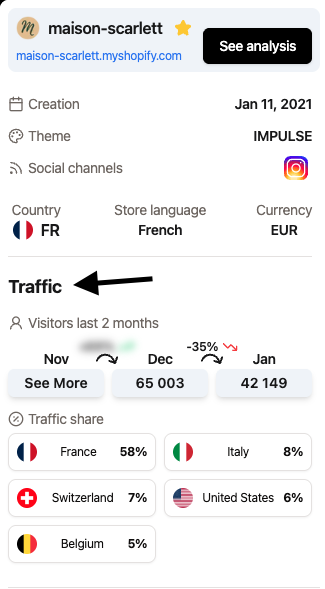
This means you don’t just see static numbers you see traffic trends. Are they growing month over month? Experiencing seasonal spikes? Facing declines?
Benchmarking traffic trends gives you predictive insight. If a competitor’s traffic suddenly accelerates, it may indicate aggressive ad scaling or a viral product. If traffic steadily declines, it may signal market saturation or weak acquisition strategies.
Contextual traffic data strengthens your competitive analysis.
Identify Their Marketing Channels and Creative Strategy
TrendTrack goes beyond surface-level metrics. You can determine whether competitors are running Facebook ad creatives and actively investing in paid campaigns.
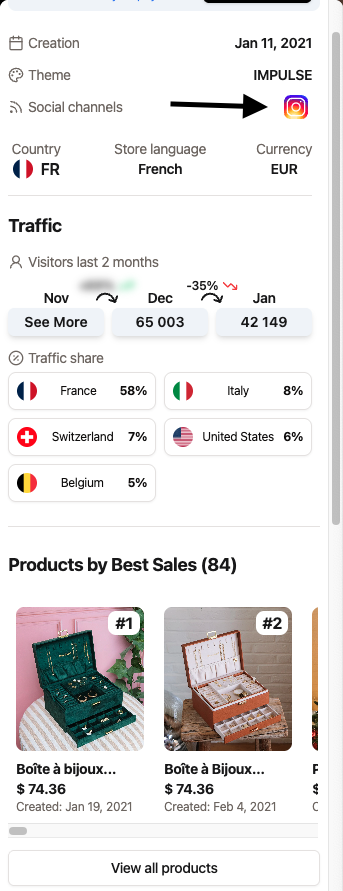
This is critical for benchmarking your acquisition strategy. If competitors are scaling with ads, you can evaluate whether your own advertising performance aligns with market dynamics.
You also gain visibility into which social media platforms they use. Are they active on Instagram, TikTok, or Pinterest? Are they building organic audiences alongside paid traffic?
Channel benchmarking allows you to understand where attention is concentrated in your niche.
Discover Traffic Geography and Market Reach
Another key benchmarking advantage is geographic insight. TrendTrack reveals which countries generate traffic for your competitors.
This data helps you evaluate international expansion opportunities. If a competitor receives significant traffic from specific regions, it may indicate untapped markets you can explore.
Geographic benchmarking supports smarter scaling decisions.
Analyze Shopify Apps and Store Infrastructure
TrendTrack also provides insight into the Shopify applications your competitors are using.
This allows you to benchmark not just marketing metrics, but operational strategy. Are they using upsell apps? Subscription tools? Advanced analytics integrations? Understanding their tech stack reveals how they optimize conversions and improve customer experience.
You can also see the store creation date, which helps you evaluate maturity and growth speed. A young store generating high traffic may signal aggressive scaling potential.
The Most Complete Benchmarking Tool for E-Commerce
True benchmarking requires visibility across multiple dimensions: traffic, products, marketing channels, technology, and positioning. TrendTrack centralizes all of this data into one intelligence ecosystem designed exclusively for e-commerce sellers.
It eliminates guesswork. It removes blind spots. It gives you the best KPIs to compare performance accurately and strategically. If you’re serious about building data-driven growth, TrendTrack is the most powerful solution you can use.
Sign up on TrendTrack today to access the insights that will elevate your benchmarking strategy and give you a true competitive advantage.
FAQ on E-Commerce Benchmarking
What is e-commerce benchmarking?
E-commerce benchmarking is the process of comparing your online store’s performance against competitors, industry averages, or past results. It helps you understand whether your key metrics such as conversion rate, traffic, or customer acquisition cost are strong, weak, or aligned with market standards.
Why is benchmarking important for online stores?
Benchmarking is essential because it provides performance context. Without comparison, your data exists in isolation. Benchmarking allows you to identify growth gaps, detect optimization opportunities, and make informed strategic decisions based on real market positioning.
What metrics should I benchmark in e-commerce?
The most important e-commerce KPIs to benchmark include conversion rate, average order value (AOV), customer acquisition cost (CAC), return on ad spend (ROAS), monthly traffic, customer lifetime value (LTV), and cart abandonment rate. These metrics directly impact growth and profitability.
How often should I benchmark my store’s performance?
Benchmarking should be done regularly. Monthly reviews allow you to track short-term trends, while quarterly analysis helps evaluate long-term strategy. In fast-moving niches, more frequent monitoring may be necessary to stay competitive.
What is the difference between competitive and industry benchmarking?
Competitive benchmarking compares your store directly to specific competitors in your niche. Industry benchmarking compares your performance to broader market averages. Both provide valuable insights, but competitive benchmarking offers more precise positioning data.
Can benchmarking improve profitability?
Yes. By identifying underperforming metrics such as high acquisition costs or low conversion rates benchmarking highlights areas for optimization. Improving these metrics directly increases margins and long-term profitability.
Is benchmarking only useful for large e-commerce brands?
No. Benchmarking benefits stores of all sizes. For small and mid-sized businesses, it provides clarity and direction. For larger brands, it supports strategic scaling and competitive dominance. Data-driven comparison is valuable at every growth stage.
What tools can help with e-commerce benchmarking?
Specialized tools like TrendTrack allow you to analyze competitors’ traffic, best sellers, marketing channels, and store performance indicators. Using the right intelligence platform ensures your benchmarks are accurate and actionable.


.avif)


Are you ready to get the insights?
From viral trends to million-dollar stores — unlock the insights behind what sells, scales, and converts. All in one place.